

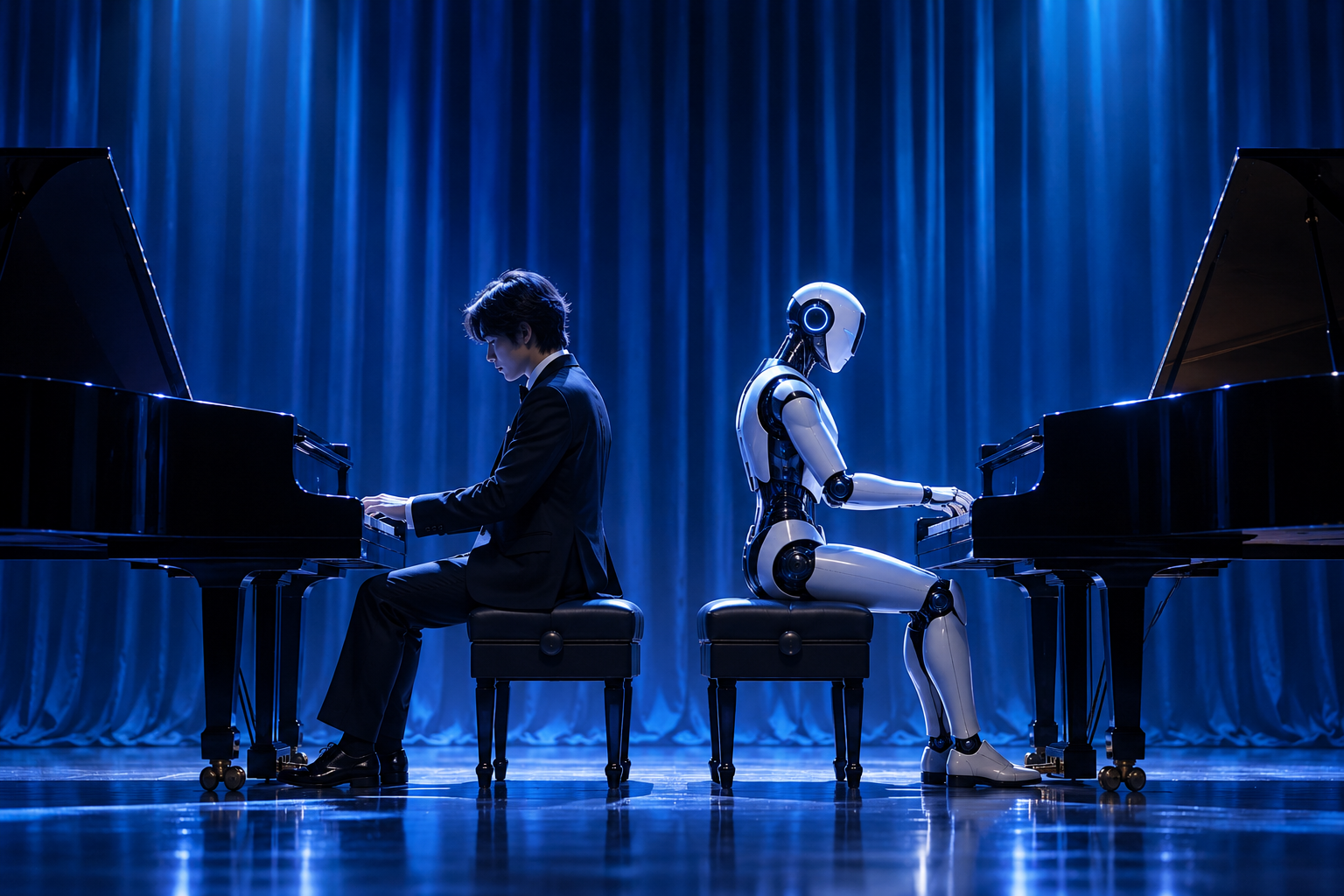
I’m the founder of pianist.bot. I initially set out to organize the inaugural Acoustic Turing League — a competition designed to explore a deceptively simple question:
Can we tell whether a piano performance comes from a human or a robot, simply by listening?
The idea was to invite robotics companies to participate, place their performances behind a curtain, and let listeners make their judgments based on what they hear rather than what they see.
The principle was straightforward: let the performance speak for itself.
I began identifying potential participants with the help of LLM-assisted research. Several robotics companies appeared to be exploring relevant capabilities, and I was eager to see whether an inaugural competition could bring them together.
Then I took a closer look at their official websites and available demonstrations.
What I found was not a reason to dismiss the idea, but a reason to reconsider its timing.
Robotic musical performance is still an evolving field. Some demonstrations show intriguing early capabilities, while others raise questions about repeatability, dexterity, control methods, and the extent to which a performance reflects autonomous operation rather than a carefully prepared sequence.
These are not criticisms of individual companies. Robotics is an extraordinarily difficult engineering discipline, and early demonstrations have their own value. They reveal what researchers are attempting, what has become possible, and where substantial technical work remains.
But a competition needs more than an interesting demonstration. It needs a sufficiently mature pool of participants, meaningful differences in performance, and a framework that can produce credible and repeatable results.
I began to realize that launching the league too early might force the event to run ahead of the technology it was intended to evaluate.
So I decided to change the order of operations.
First, observe the field. Then, build the league.
Rather than rushing to organize the inaugural competition, I intend to develop Pianist.bot as a platform for tracking the progress of robotic musical performance.
The immediate goal is to follow relevant companies, document meaningful technical milestones, examine publicly available demonstrations, and build a clearer picture of how robotic musical capabilities develop over time.
The emphasis will not be on promotional claims alone. It will be on observable evidence.
What can a robot actually perform? Under what conditions? How repeatable is the result? Which capabilities are improving, and which challenges remain unresolved?
A demonstration is a snapshot. A sustained record of demonstrations can reveal a trajectory.
Over time, this approach should also help identify companies whose work is worth following, establish relationships with potential participants, and clarify what a fair and meaningful acoustic Turing test should require.
It may also help distinguish between different stages of development: a robot that can execute a prepared sequence, one that can perform reliably under controlled conditions, and one whose musical output can genuinely challenge human listeners in a blind test.
These stages should not be casually treated as equivalent.
The competition is still the destination
The Acoustic Turing League remains the long-term objective.
I do not see the change in approach as abandoning the competition. I see it as preparing the ground for one that deserves to exist.
A credible league should emerge when the technology, the participants, and the evaluation framework are ready to support it — not merely because an organizer has announced a date.
Until then, there is meaningful work to do: follow the evidence, understand the technical trajectory, engage with the people building these systems, and gradually establish the conditions under which a competition can produce results worth taking seriously.
The ambition is not simply to stage a contest between humans and robots.
It is to create a lasting reference point for the development of robotic musical performance — one that can document progress before the field reaches maturity and eventually provide a credible stage on which human and robotic performers can be compared.
The first step may not be to ask who wins. It may be to understand how the field is progressing toward a competition worth holding.
The Acoustic Turing League can wait for the right moment.
The observation begins now.